FreeTime Uusimaa
The project explores how families can discover free, child-friendly events in the Uusimaa region without spending time searching across multiple platforms.
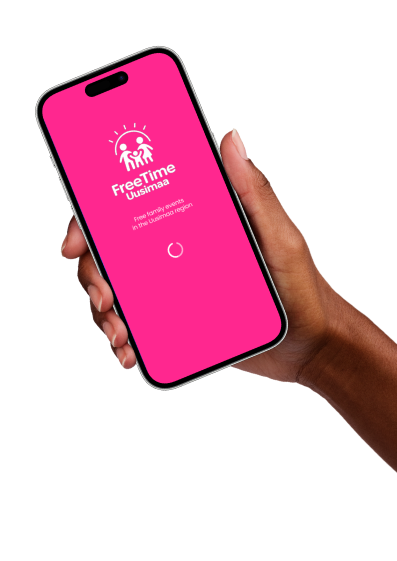
The mobile app is the primary focus of this case, supported by a complementary web experience. The key challenge was designing a solution that works for families with limited time and different language backgrounds, while fitting into an existing ecosystem of public events and fragmented data sources. The problem was later independently addressed by emerging products in the Finnish market.
01 //
Problem & Goal
Problem: parents in the Uusimaa region often struggle to find free, child-friendly events in one convenient place. Relevant information is scattered across multiple websites, libraries, and social media groups, making the search time-consuming and unreliable.
Goal: design a simple, accessible platform, where families can easily discover free local activities for kids and plan enjoyable time together without unnecessary effort.
02 //
Research
To better understand the needs of international families in Uusimaa, I conducted an online survey through local Facebook groups. The survey was conducted in English to reflect the project’s initial focus on international families and to ensure accessibility for parents who may not be fluent in Finnish.
The results showed that event information is scattered across multiple sources and often lacks clear filtering options. Even platforms focused on event discovery promote mainly paid events and make it difficult to search by age, location, or category.
Many parents expressed a need for:
- an easy way to find free events nearby
- age-appropriate event suggestions
- complete and trustworthy event information
- a mobile-friendly tool that works well when planning spontaneously
These insights highlighted the need for a centralized platform with effective filters that helps families quickly discover free events suitable for their children.
03 //
Persona & User Journey Map
Sarah Miller
37 • Espoo, Finland • Married, 2 children
Remote English teacher • Bachelor’s degree
Sarah is a mother of two living in Espoo who recently moved to Finland from the United States. She works remotely as an online English teacher and is still getting familiar with local services and activities.
Balancing work and family life, she has limited time to search across multiple platforms for suitable events. She needs a centralized, mobile-friendly tool to quickly find trusted, free, and age-appropriate activities. Sarah values clarity, reliability, and simplicity, and wants planning family time to feel easy rather than stressful.
“I just want to find something fun and free to do with my kids this weekend - without digging through multiple platforms.”
Goals
- Discover local free events suitable for her children
- Save time by having all relevant event information in one place
- Get inspired with new activity ideas every week
- Quickly find events that match her children’s ages and interests
Frustrations
- Event information is scattered across different websites and Facebook groups.
- Difficult to filter events by age, location, or category
- Poor mobile experience and no easy way to save events or set reminders
- Most platforms focus on paid events rather than free family activities
04 //
Usability Test
I tested mobile and web prototypes with international parents living in Finland and iterated based on their feedback. The findings below informed the subsequent design iteration. Usability testing findings for the website version are available in the full case study.
- Discoverability of events — users needed a clear way to start browsing → added a visible “Find Events” button
- Navigation clarity — icons alone caused confusion → added text labels under bottom navigation icons
- Sharing experience — parents wanted to send event links to others → planned event sharing after testing and added it in the subsequent design iteration
05 //
Design Decisions
The following design decisions were implemented in the iteration after usability testing.
- Events are presented as clear, card-based layouts with key details, including distance in kilometers, and a prominent “Find Events” button to support easy browsing.
- Filters are based on event types and user needs identified through user research (age, location).
- The tab bar highlights the core features of the app using labeled icons to support clear and predictable navigation.
- Event details are consolidated into a single view to support decision-making, with an option to share the event.
- Event notifications have been added to help users remember upcoming events.
- Through the Favorites view, users can filter events they are interested in, such as music, dance, and culture.
06 //
Product & Business Context — North Star Metric
For the FreeTime Uusimaa service, success is defined first and foremost as real participation in events, not merely browsing or saving activities.
In the solution, this is reflected especially in how event discovery, review, and remembering are combined into one coherent flow. After an event, users can, if they wish, confirm their participation through a notification, creating a simple and measurable connection between the digital service and the real-life experience.
The Profile and Activity Calendar make participation history visible to the user. Visited, saved, and shared events are summarized as numerical indicators that provide access to detailed activity views.
The solution supports the product’s core value by focusing on real participation rather than passive browsing.
07 //
A Later Market Signal
FreeTime Uusimaa started as a student concept based on a real problem I identified during research: information about children’s activities was fragmented across different websites, social media pages and local services, making it difficult for families to discover suitable options in one place.
At the time, the project remained a UX/UI concept and was not developed into a live product.
Later, similar services began appearing in Finland, addressing the same underlying problem of helping parents discover children’s hobbies and activities more easily.
For me, this became an interesting validation of the original problem rather than of the specific solution. It showed that the need identified during the project was not only hypothetical and reinforced the importance of looking beyond the interface to understand whether a real user problem is worth solving.
08 //
Localization for Finnish Users
After completing the original English-language concept, I localized the application for Finnish-speaking families living in the Uusimaa region. The project focused on adapting terminology, content, and the user experience to the local context while preserving the validated UX structure.
09 //
Takeaways
This project showed that the main challenge for families is the fragmentation of information about free, child-friendly events across multiple platforms, as well as the absence of a single, well-structured solution.
A mobile-first approach, supported by a complementary web experience, helps families plan activities more easily in everyday, time-constrained situations.
The project was started in 2025 and further refined in January 2026 as an independent UX case study. It presents the product concept and design decisions developed during the design process.